
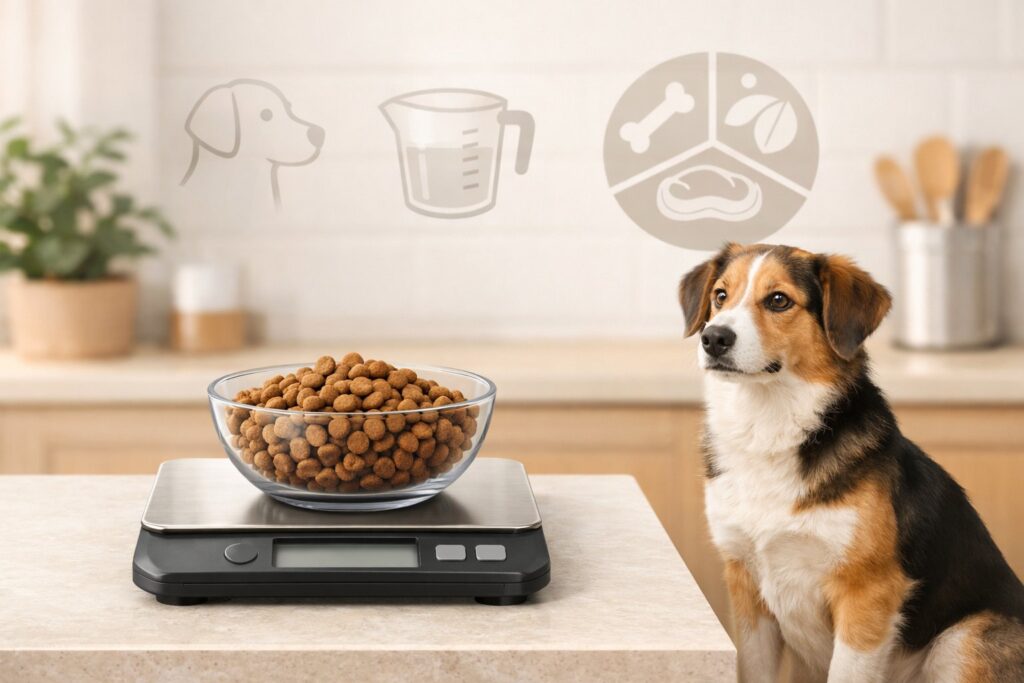
Figuring out how much to feed your dog isn’t as simple as eyeballing it or just reading the back of the bag. A dog food portion calculator helps you determine the exact amount of food your dog needs each day based on their weight, activity level, and life stage, so you can avoid overfeeding or underfeeding.
Getting portions right matters—it affects your dog’s energy, weight, and long-term health. You’ve probably wondered if you’re feeding too much or too little, especially when your pup gives you those pleading eyes at mealtime.
The truth is, feeding guidelines on commercial dog food packages are just starting points. They don’t always account for your dog’s unique needs.
That’s where a portion calculator comes in handy. Whether you’ve got a tiny Chihuahua or a giant Great Dane, you’re about to discover how to keep your dog at a healthy weight without all the guesswork.
Key Takeaways
- Dog food portion calculators use your dog’s weight, activity level, and life stage to determine daily food amounts
- Breed size, age, and metabolism all affect how much your dog should eat each day
- Regular monitoring and portion adjustments help maintain your dog’s ideal body weight and overall health
What Is a Dog Food Portion Calculator?
A dog food calculator helps you figure out exactly how much food your dog needs each day. It takes into account their weight, age, activity level, and health status.
Instead of guessing or relying on the feeding chart printed on your dog food bag, these tools give you a personalized amount that fits your specific pup’s needs.
How Dog Food Calculators Work
Dog food calculators use your dog’s info to estimate their daily calorie needs, then convert that into cups or grams of food. You’ll usually enter details like your dog’s current weight, whether they need to lose or gain weight, and how active they are throughout the day.
Most calculators start by calculating the metabolizable energy content your dog needs just to maintain their weight. Then they factor in whether your pup is a couch potato or runs agility courses on weekends.
The math considers how many calories are in each cup of your specific food. A high-quality kibble might pack 400 calories per cup, while a weight-loss formula could have just 250 calories in the same amount.
Personalized Nutrition vs. Bag Guidelines
The feeding guidelines on your dog food bag are really just starting points. They’re written for an “average” dog, but honestly, who actually has an average dog?
Your Chihuahua who zooms around the house all day needs different portions than a laid-back Pug of the same weight. Commercial dog food feeding guidelines often provide wide ranges because every dog is unique.
A dog food portion calculator adjusts for these differences. It accounts for whether your dog is spayed or neutered, senior or puppy, athletic or sedentary.
These factors can change calorie needs by 20-40% compared to those generic bag recommendations.
Why Every Scoop Counts
Getting portion sizes right matters more than you might expect. Research shows that dog owners measuring food volumes with different devices often end up feeding significantly different amounts than intended.
Using the wrong measuring cup or just eyeballing portions can lead to overfeeding by 50% or more over time. That extra quarter-cup per meal adds up to thousands of unnecessary calories each year.
Accurate dog food portions help keep your dog’s weight in check and prevent obesity-related health problems. When you know the exact amount your dog needs, you can adjust portions as they age, recover from illness, or change activity levels throughout the year.
Key Factors That Influence Your Dog’s Food Portions
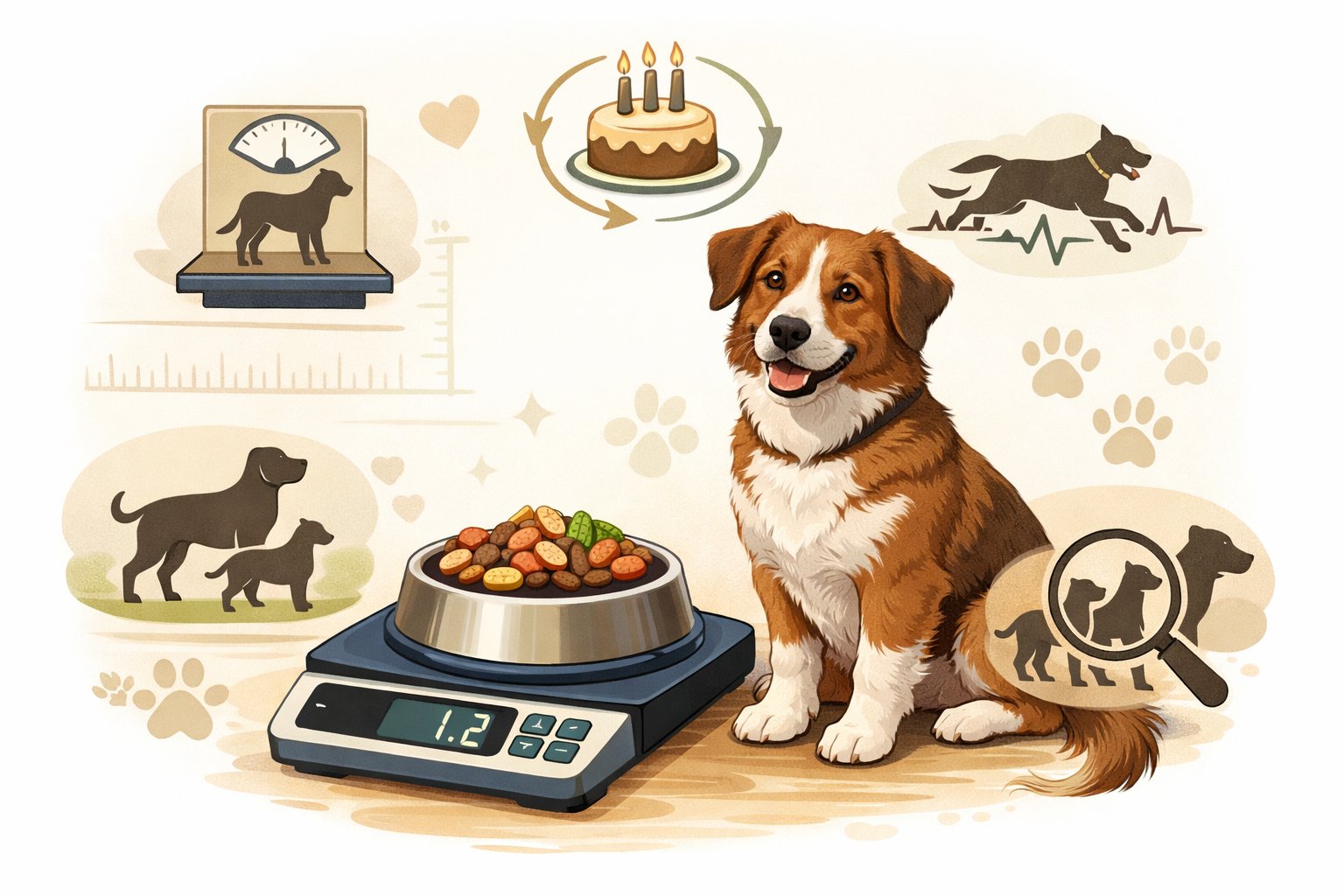
Getting your dog’s portions right isn’t just about filling a bowl. Your dog’s weight, activity level, and the calorie content of their food all work together to determine how much they actually need.
Weight and Body Condition Score: The Power Duo
Your dog’s body condition score matters more than the number on the scale. Two dogs can weigh 30 pounds, but one might be lean and muscular while the other’s carrying extra fat.
Weigh your dog regularly and check their body shape. Run your hands along their sides—you should feel their ribs without pressing hard, but they shouldn’t stick out.
Look at them from above and check for a visible waist behind the ribs. Research shows owners often misjudge their dog’s weight and body condition, which leads to overfeeding.
If your dog scores above a 5 on the standard 9-point scale, they’re overweight and need smaller portions than the bag suggests. A dog at their ideal weight needs different portions than one who’s 10 pounds over.
Start by calculating portions for their target weight, not the current weight if they need to lose pounds.
Activity Levels and Life Stages
Your couch potato Basset Hound needs way less food than your Border Collie who runs agility courses three times a week. Activity level directly impacts how much energy your dog burns.
Life stage changes everything too. Puppies need more calories per pound since they’re growing, while senior dogs often need less because their metabolism slows down and they move less.
Here’s what affects your dog’s energy needs:
- High activity (working dogs, athletes): 1.5 to 2 times more calories
- Moderate activity (daily walks, playtime): standard portions
- Low activity (minimal exercise): 20-30% fewer calories
- Puppies: up to 2 times adult portions
- Pregnant or nursing dogs: significantly more food
Adjust portions every few months as your dog ages or their routine changes. That active young dog? Eventually, they’ll slow down.
Decoding Calories Per Cup and Food Type
Not all dog food delivers the same energy. One cup of high-calorie performance food can pack 500 calories, while the same amount of weight management food might have just 250 calories per cup.
Check the calories per cup on your dog food bag—it’s usually listed as kcal/cup in the feeding guidelines. This number determines how much you actually scoop out.
The bowl and scoop size you use can make you overfeed without realizing it. Studies found owners portioned up to 34 grams more food when using large bowls and scoops compared to smaller ones.
Use a standard measuring cup, not the scoop that came with the food or a random cup from your kitchen. Write down the calories per cup for your specific food and calculate portions based on your dog’s daily calorie needs, not just the bag’s generic suggestions.
Wet food contains more water and fewer calories per cup than dry kibble, so you’ll feed larger volumes if you switch food types.
Formulas and Steps for Calculating the Right Portion
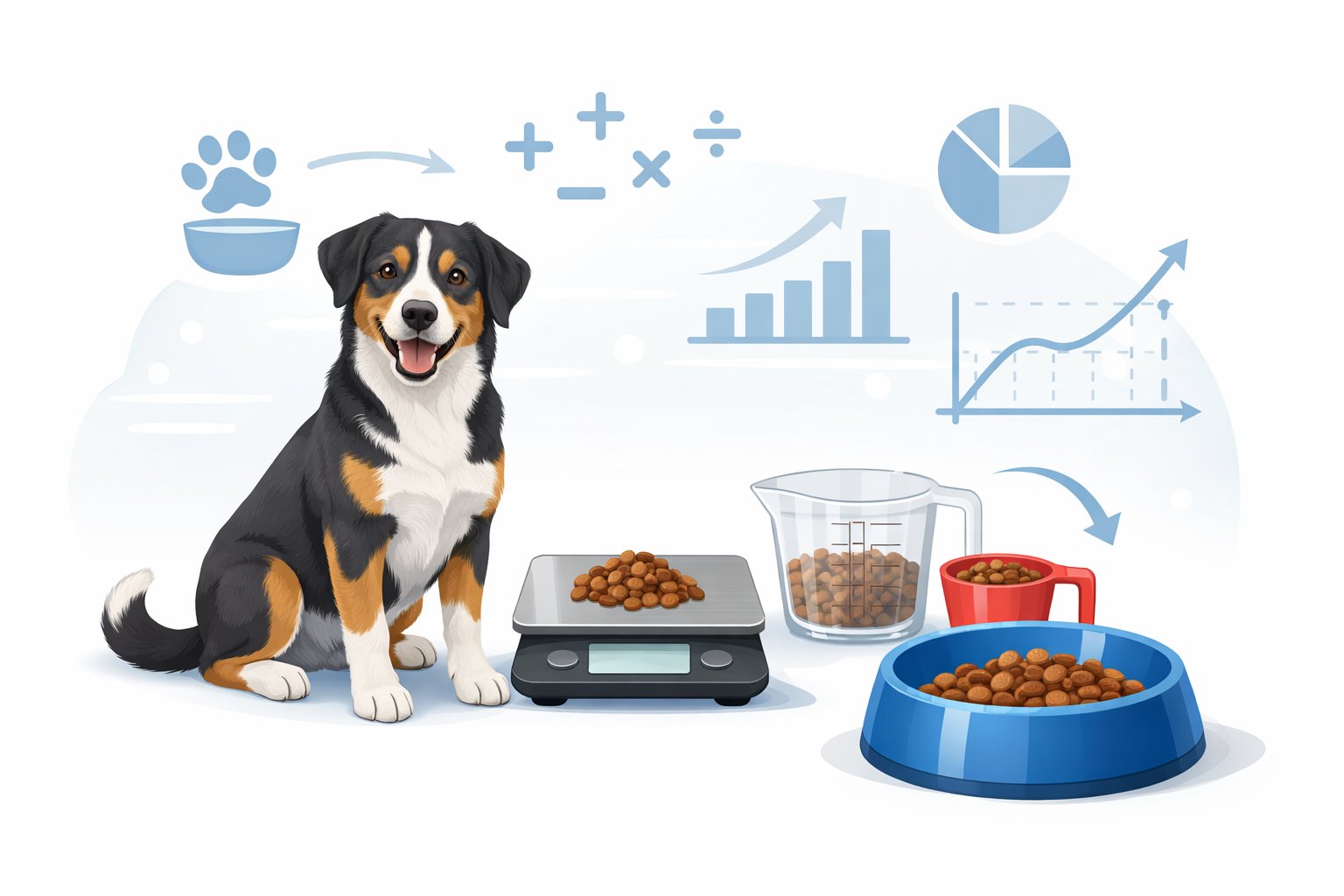
Figuring out exactly how much food your dog needs starts with a few key calculations. Veterinary professionals use these steps all the time.
The process involves calculating your dog’s resting energy requirement first, then adjusting it based on their activity level and life stage to determine their daily calorie needs.
Resting Energy Requirement and Metabolizable Energy
Your dog’s resting energy requirement (RER) represents the calories they’d burn just lying around all day doing absolutely nothing. It’s the baseline number you need before making any adjustments.
The standard formula for RER is: RER = 70 × (body weight in kg)^0.75
If math isn’t your thing, here’s a simpler version for dogs between 2 and 45 pounds: multiply your dog’s weight in kilograms by 30, then add 70. So a 10 kg dog would need roughly 370 calories at rest.
Once you know the RER, you need to understand metabolizable energy. This refers to the actual calories your dog can absorb and use from their food.
Pet food labels often use metabolizable energy calculations to determine the caloric content listed on the bag. Most quality dog foods list their metabolizable energy content as kcal/kg or kcal/cup.
If it’s not on the label, contact the manufacturer directly. Sometimes you have to dig a little.
Maintenance Energy Requirement and Adjustments
Your dog’s maintenance energy requirement (MER) takes their RER and multiplies it by a factor based on their lifestyle. Here’s where things get personal to your pup.
Here are the common multipliers:
- Neutered adult dogs: RER × 1.6
- Intact adult dogs: RER × 1.8
- Weight loss: RER × 1.0 to 1.2
- Weight gain: RER × 1.2 to 1.8
- Active/working dogs: RER × 2.0 to 5.0
- Puppies (4-12 months): RER × 2.0 to 3.0
- Senior dogs: RER × 1.4
A dog calorie calculator can help you determine these numbers quickly. Still, understanding the math helps you adjust portions as your dog’s needs change.
Step-By-Step Guide: Crunching the Numbers
Let’s walk through a real example so you can see how this works for your own dog.
Step
1
Start weighing your dog and convert pounds to kilograms. Just divide by 2.2. So, a 22-pound dog weighs 10 kg. By waking up at the same time every day, even on weekends, to regulate your body’s internal clock.
Step
2
Calculate RER using the formula. For a 10 kg dog: 70 × (10^0.75) = about 370 calories.
Step
3
Figure out your dog’s lifestyle multiplier. If they’re a neutered, moderately active adult, use 1.6.
Step
4
Calculate MER. In this case: 370 × 1.6 = 592 calories per day.
Step
5
Check your dog food’s calorie content per cup or per 100g. Let’s say it’s 350 kcal per cup.
Step
6
Divide the daily calories needed by calories per cup: 592 ÷ 350 = 1.7 cups per day.
How to Use a Digital Scale or Measuring Cup
Now that you’ve got your numbers, measuring accurately can make all the difference. Here’s something wild: pet owners often overestimate portions by up to 80% when using measuring cups.
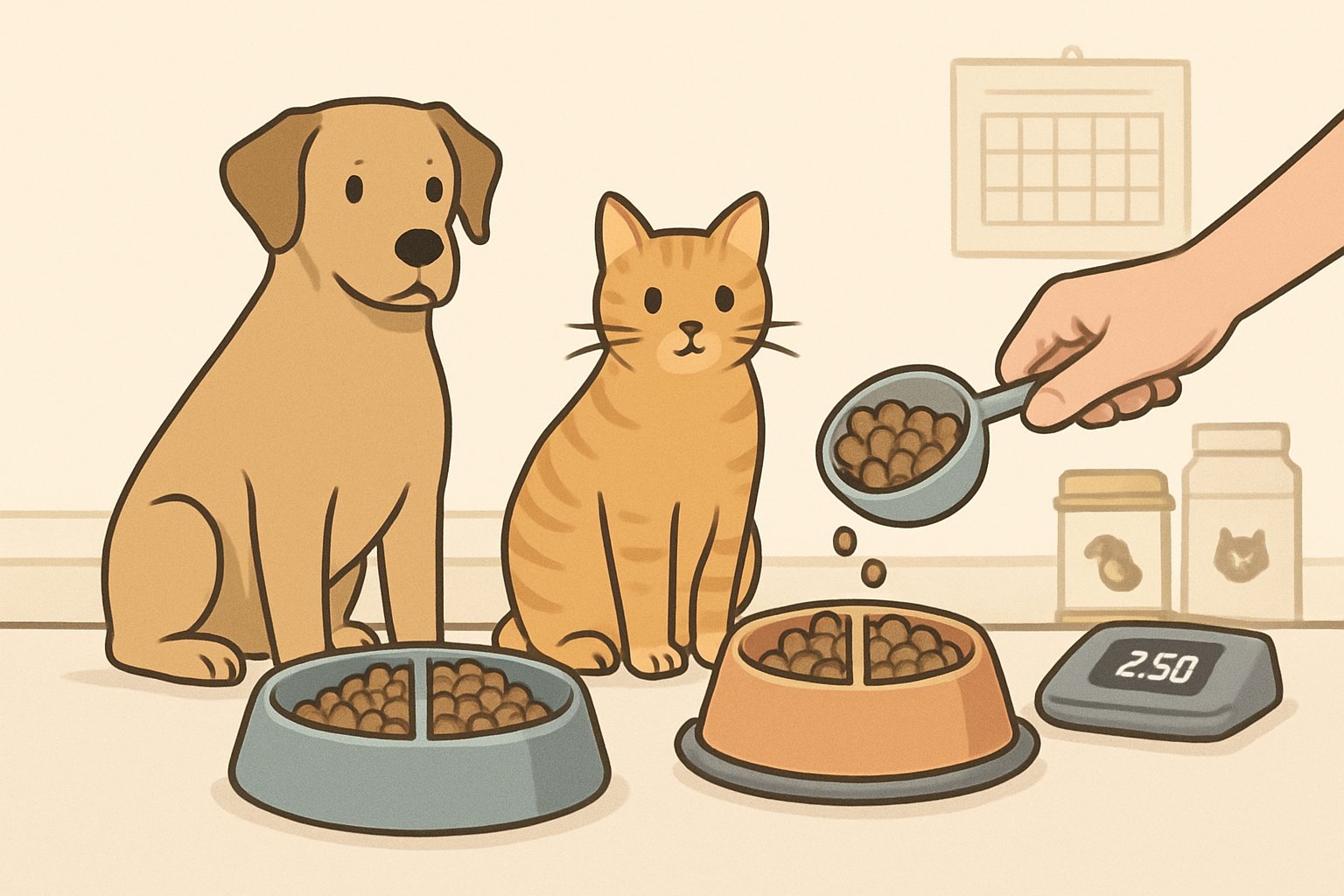
Using a digital scale is your most accurate bet. Put your dog’s bowl on the scale, zero it out, then add food until you hit the right gram amount. Most pet food bags list serving sizes in grams next to cup measurements.
If you use measuring cups, keep these tips in mind:
- Use a real measuring cup, not a mug or random scoop
- Level off the top with a straight edge
- Don’t pack the food down or shake it to fit more
- Measure kibble before adding any mix-ins
For wet food, a kitchen scale matters even more. The texture makes cup measurements unreliable. Weigh the can or pouch before and after scooping to know exactly how much you’re serving.
Track your dog’s weight weekly for the first month after you calculate portions. If your pup is gaining or losing unexpectedly, tweak your calculations by about 10% and check again in two weeks.
Keeping Your Dog Healthy: Tips for Monitoring and Adjusting Portions
Getting your dog’s portions right isn’t a one-and-done thing. Your pup’s weight, energy, and body shape tell you whether you’re feeding too much, too little, or just enough.
Signs You’re Overfeeding or Underfeeding
You don’t need a scale to spot trouble. If your dog is gaining weight, seems sluggish after meals, or begs all the time, you might be overfeeding.
Look at your dog from above. You should see a waist behind the ribs.
Run your hands along their sides. You should feel ribs easily without pressing hard, but they shouldn’t poke out like a xylophone.
Signs of overfeeding include:
- Fat deposits around the neck, chest, or base of tail
- Waist disappears when viewed from above
- Difficulty jumping, playing, or climbing stairs
- Heavy breathing during light activity
Underfeeding looks different. Your dog might act tired, lose muscle, or have a dull coat. Research on managing dog weight shows lots of owners miss when their dog is overweight.
Underfeeding warning signs:
- Ribs, spine, and hip bones clearly visible
- Sunken look around the hips
- Low energy or reluctance to play
- Thin, brittle coat or excessive shedding
Weigh your dog monthly at home or at the vet. Track the numbers. A sudden two-pound gain on a small breed can be a big deal.
When to Consult a Veterinary Nutritionist
Sometimes your regular vet isn’t enough. If your dog has diabetes, kidney disease, or food allergies, you need a veterinary nutritionist.
A veterinary nutritionist can create custom meal plans for your dog’s health issues. They use your dog’s body condition score, activity level, and medical needs to calculate portions. This is way beyond what a feeding chart can do.
Book an appointment if:
- Your dog gains or loses weight even when you follow feeding guidelines
- Your pup has a chronic condition like pancreatitis or heart disease
- You’re feeding a homemade diet and want to check it’s balanced
- Your dog refuses commercial food or needs a prescription diet
These specialists use detailed energy calculations that cover factors regular feeding guides miss. They’ll show you how to weigh your dog and interpret body condition at home.
Honestly, it’s worth it. Dogs with managed nutrition live longer and enjoy a better quality of life.
Tweaks for Puppies, Seniors, and Special Diets
Puppies burn through calories like crazy. They need more food per pound than adults since they’re building bone, muscle, and brain tissue.
Feed puppies three or four times daily until they’re six months old. Split their daily portion into smaller meals to avoid blood sugar crashes. Guidelines for feeding growing dogs suggest monitoring and adjusting as they grow.
Puppy feeding adjustments:
- 8-12 weeks: Four meals daily, roughly 5-10% of body weight
- 3-6 months: Three meals daily, adjust portions after weekly weigh-ins
- 6-12 months: Two meals daily, slowly transition to adult portions
Senior dogs slow down. Their metabolism drops, they move less, and they need fewer calories. Keep the same number of meals but cut portions by 20-30%.
Watch their body condition score closely. Seniors gain weight quickly but can lose muscle at the same time. Sometimes you’ll see fat over the ribs but bony hips.
Special diet considerations:
- Grain-free diets: Monitor heart health and adjust protein sources
- Weight loss plans: Reduce portions by 25% and measure everything
- Prescription diets: Follow your vet’s portions and skip the treats
Adjust every couple of weeks based on what you see and feel. Your hands and eyes can tell you more than any calculator if you know what to look for.
Frequently Asked Questions
Switching food types, adjusting portions for different breeds, and figuring out how much to feed based on activity level all take different math. A dog food portion calculator helps you find the right amount, but you need to adjust it for your situation.
Wondering how to adjust Fido’s meals when switching from dry kibble to a wet food diet?
Here’s the thing: wet food has way more water than kibble, so you can’t just swap cup for cup.
Most wet food is about 75% to 80% water, while dry kibble is around 10%. That means wet food has fewer calories per cup. If your dog eats one cup of kibble a day, you’ll need three to four times that in wet food to match the calories.
Use a dog food portion calculator and compare calories per cup on both food labels. Multiply your dog’s daily calorie needs by the wet food’s calorie content to get the right amount. Most calculators let you pick the food type, so the math’s done for you.
You know that each breed has its quirks, right? How does that factor into the amount of grub they get?
Breed size makes a huge difference in how you calculate portions.
Small breeds like Chihuahuas have fast metabolisms and need more calories per pound than a Great Dane. A study on commercial dog food feeding guidelines found that manufacturers use different energy equations for toy breeds, large breeds, or general maintenance.
Your dog food portion calculator should ask for breed size or weight range. Tiny dogs might need 40 calories per pound, while giant breeds might need only 20. Activity level matters too, but breed metabolism sets your baseline.
Let’s be real, homemade dog chow is a labor of love. But how much should you be plating up?
Making your own dog food means you control every ingredient, but getting portions right is tricky without commercial labels.
You’ll need to add up the calories from each ingredient in your recipe, then divide by servings. Research shows that evaluating home-prepared diets takes careful calorie analysis.
Once you know calories per serving, plug that into your dog food portion calculator with your dog’s weight and activity level. Most calculators work with any food if you have the calorie counts. Double-check your homemade meals hit all nutritional needs, not just calories.
Ever scratched your head trying to put a number on how much your growing pup should eat based on their fuzzy milestones?
Puppies throw a wrench in standard calculators because their needs change all the time.
Growing pups need about twice the calories per pound compared to adult dogs of the same breed. But here’s the twist: feed amounts shift as they hit different growth phases. A three-month-old Lab puppy needs different portions than that same pup at six months.
Your best bet? Use a dog food portion calculator built for puppies that adjusts for age and expected adult weight. Most good calculators will ask for age and breed to estimate growth. Weigh your pup weekly and adjust portions as they grow, because what worked last month might be too little now.
Consider this: Do the usual portion recommendations change when you’re dealing with a furball that’s either underweight or on the pudgier side?
Absolutely. Body condition matters way more than just the number on the scale.
Standard calculators assume your dog sits at an ideal weight. If your dog’s carrying extra pounds, you’ll want to calculate portions based on their target weight, not their current weight.
For underweight pups, it’s the opposite—base portions on the weight they should reach.
Research on dog obesity and weight management points out that healthy weight depends on adjusting both exercise and food portions.
Try a dog food portion calculator that lets you factor in body condition score. Some even have options for “overweight” or “underweight” to help fine-tune the numbers automatically.
Start with portions for your dog’s ideal weight. Then, just keep an eye on them and adjust as you go—no calculator can beat real-life observation.
If you’ve ever found yourself wondering how your dog’s activity level plays into their daily food rations, you’re not alone.
Activity level can shift your dog’s calorie needs by 50% or more in either direction.
A couch potato Lab needs way fewer calories than one that runs agility courses three times a week.
Most dog food portion calculators include activity options like “sedentary,” “moderate,” or “very active.”
These categories multiply your dog’s base calorie needs by different factors.
Pick the activity level that matches your dog’s typical day, not their occasional weekend hike.
If your pup gets a 20-minute walk daily and lounges the rest of the time, that’s moderate at best.
Working dogs, hunting breeds in season, or dogs training for sports fall into the very active category.
Your calculator will adjust portions based on this input, so try to be honest about your dog’s real activity level. It’s tempting to fudge the numbers, but your pup’s waistline will notice.